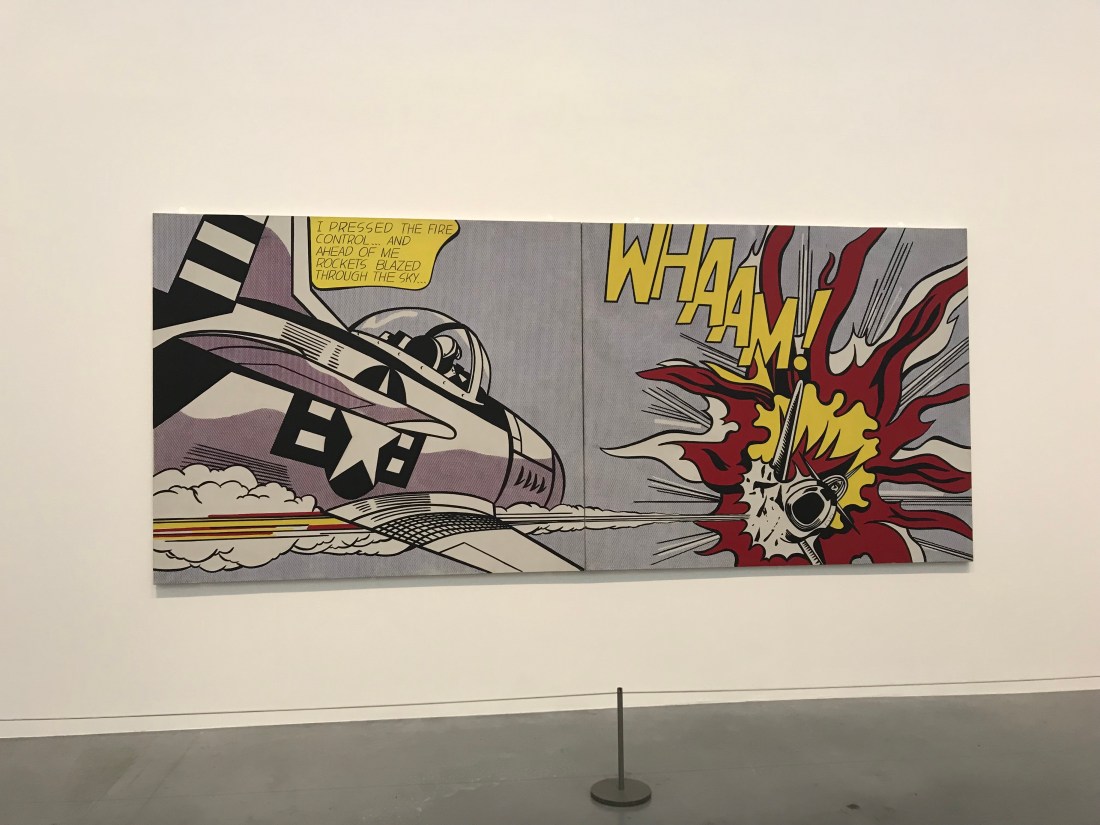
In looking at Whaam!, It’s hard to realize that technically, you are watching someone perish. The painting is able to encapsulate a time in American history where media coverage and war are first interacting–never before in history has a war been broadcast on television and this time, it was making the American population weary of it. Since the Vietnam war, as anyone living in present day society can tell you, consumers of media have since become numb to it. Was Lichtenstein able to predict the future media culture just at the advent of it? Whaam! functions as an allegory for today’s mass communication.
Whaam! was created from a comic strip in DC comics’ “All American Men of War” that was published in 1962 (Tate). In the nature of pop art, the painting is taking the mundane and elevating it by making art out of it–the ‘mundane’ being the comic and ‘elevating’ it to fine art (mainly meaning art on a canvas). It is an opinion of some though, that he has stolen the comic and slightly altered it, but Liechtenstein states “‘I am nominally copying, but I am really restating the copied thing in other terms. In doing that, the original acquires a totally different texture’ (Tate).
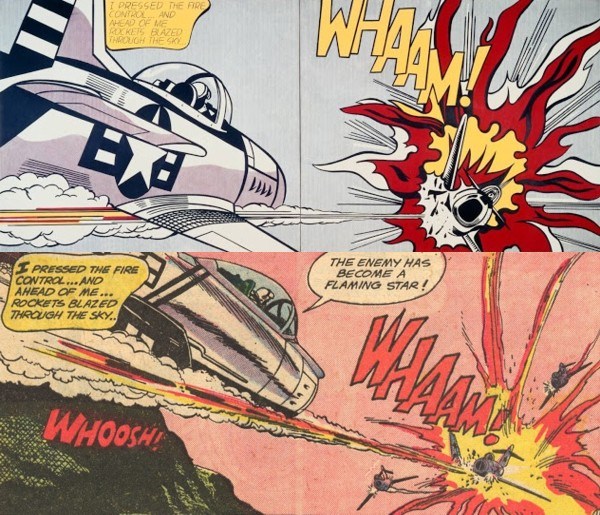
While the similarities are undeniable, it is different from the comic by including an appealing design–the lines are thick, distracting cross hatching is removed, and the colors are solid in order to make a simplified and more streamline composition. The resulting picture has a clean and almost sterile look with structurally organized benday dots aligned in neat lines.
The ‘clean’ or sterile look resulting from the meticulously structured painting completely removes it from the subject matter at hand–yes, someone is dying in the painting, but no part of it is gruesome. It is clean, playful, and pleasing to the eye with it’s use of primary colors. Blue and red elegantly sit next to each other to make a purple shadow on an elegantly blue sky. The depiction and the subject matter directly contradict each other, making something seem peculiar to the viewer upon further inspection.
Liechtenstein has accurately captured a moment of time in history, a painting embodying it’s environment and time period. One of Liechtenstein’s favorite paintings was Guernica by Pablo Picasso, a painting that also famously provided commentary on war, reflecting on the feelings of the the people in that country (Lichtenstein Foundation). Today, Whaam! is still relevant–there is an excess of media depicting gruesome deaths, epidemics, and other various horrific aspect of human suffering, yet we are numb to it. The media is able to repackage and sterilize the subject matter at hand, much as Liechtenstein is doing in Whaam! While the painting was made during one of the few times in American history where people were shocked by the war suddenly being shown in their living rooms, it predicted what future media consumption would be like. Whaam! is relevant during a time where people look at atrocities in the palm of their hand and feel completely detached from them. Media is repackaged and sent in easily digestible packages directly to out phones where consumers can feel comfortably indifferent to what they’re viewing.

 British Art