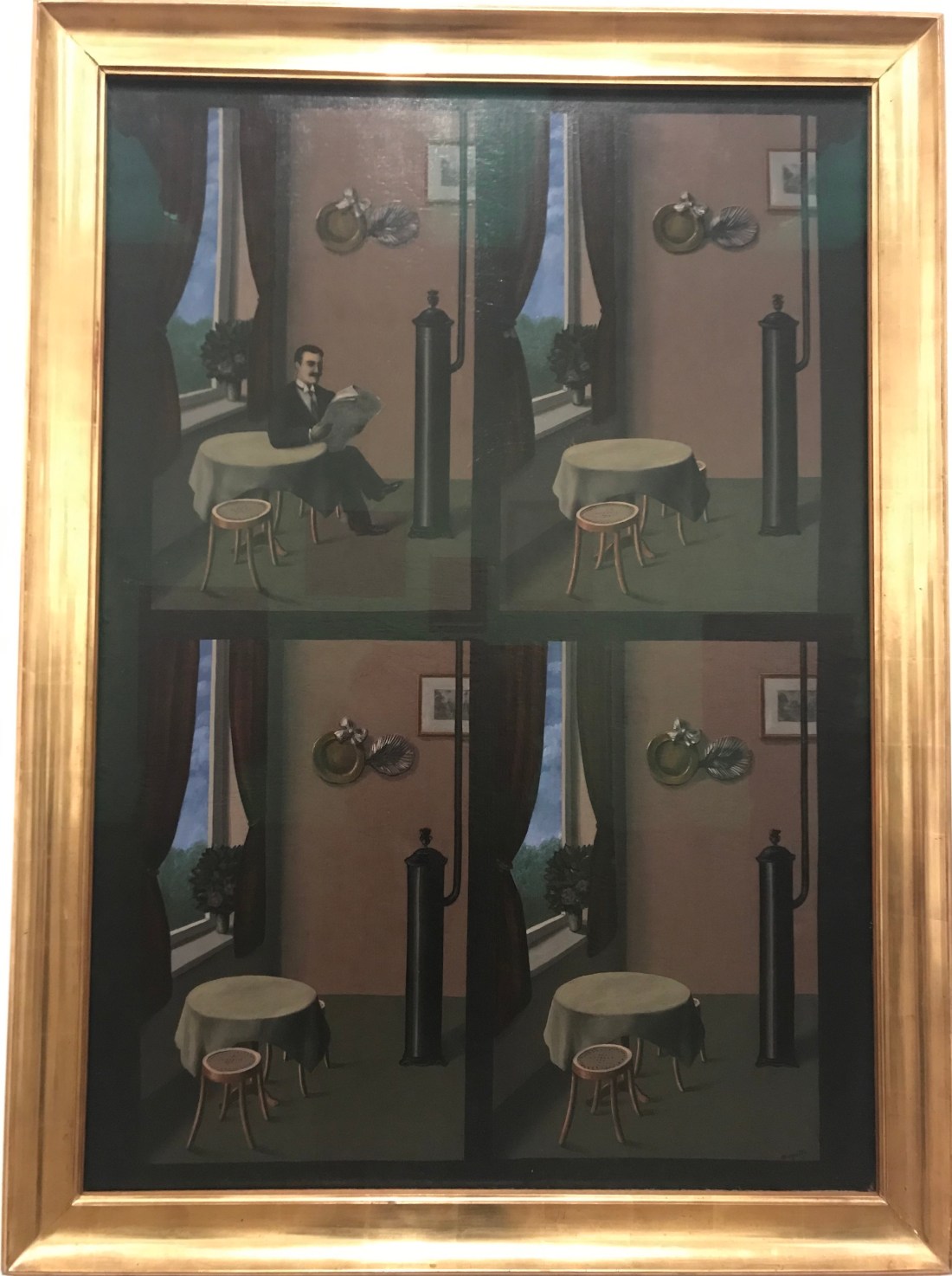
 Rene Magritte was a surrealist painter from Belgium who aimed to question our relationships with objects and language. Magritte pushed surrealism past the unconsciousness just having unhindered freedom with paint and made it something symbolic. Magritte choose to have a detailed and precise style that gives an unsettling style to viewers and created his ‘deadpan’ style of artwork (MoMA).
Magritte’s Man with a Newspaper is peculiar to any viewer from a considerable distance–as the viewer gets closer, however, uneasiness increases. The painting seems like a game of spot the difference, as there are only subtle differences between each panel, and left for the viewer to decide if they are intentional or not. There are small, unsettling and almost unnoticeable differences in the painting such as a slight shift in perspective and shadow, even though it appears to be the exact time of day (according to the clouds outside, which have not moved). Of course, the one thing that does change, is the man reading the newspaper in the first frame–suddenly, he just is not there in the consecutive three frames. The viewer is forced to wonder why he disappeared suddenly, without any movement indicated in the painting, and why he was there in the first place. Painted in a distinctly surrealist style with an uncanny use of lighting and realism, the painting makes the viewer inquire beyond the literal image at hand, and perhaps what was happening in Magritte’s unconsciousness.
Man with a Newspaper was made in 1928 during the period of time Magritte lived in Paris and was making other images in the same style of provoking, unknown plots. During 1927 to 1930, Magritte was expremening with text and image, and most famously creating Ceci n’est pas une pipe (This is Not a Pipe) (The Guardian). Within each painting seems to be a direct contradiction, most notably in his text paintings that directly deny the image, but a common theme throughout his work. In Man with a Newspaper, the image seems to be contradicting itself–how could the man have moved? He should still be there, but the three other frames deny it. Even through the style of surrealism, the lighting is also contradicting itself. In reality, the sky that shown in the windows outside would not be capable of producing the lighting in the household. The effect of lighting and the theme of the contradictory gives Magritte’s style an unsettling, almost matter of fact feeling that is bound to make the viewer second guess the objects at hand.
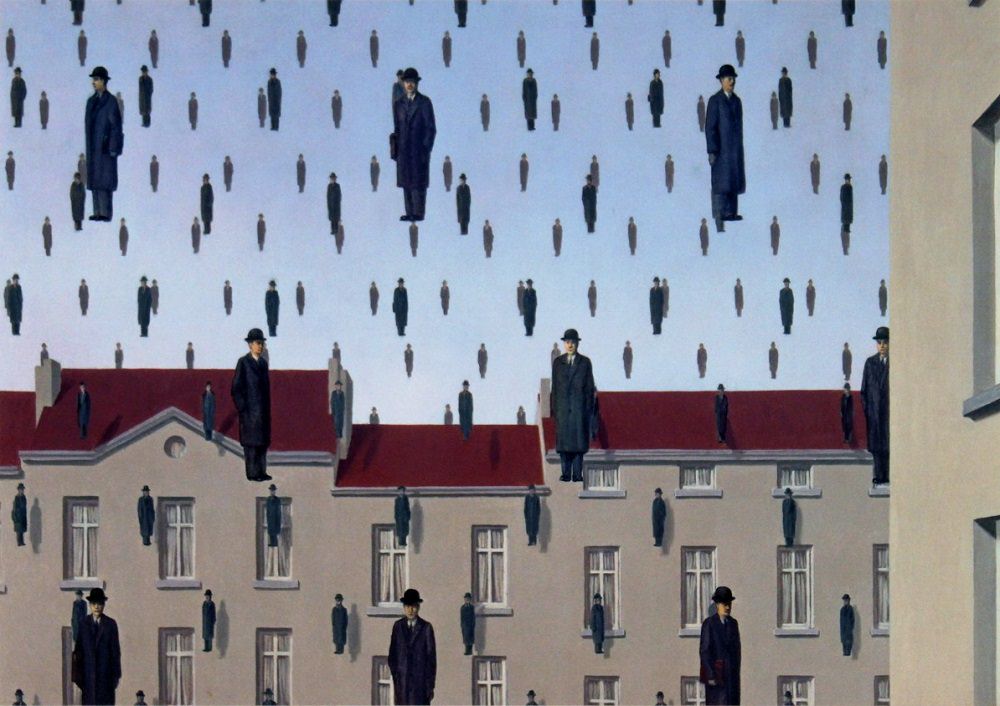
A common Motif in Magritte’s paintings are men in suits with bowler hats–they can be seen in many paintings, and the men seem to resemble each other. A Man with a Newspaper is no exception, and looks similar to other figures in Magritte’s paintings. Magritte himself was often seen wearing bowler hats and dawning a similar suit–it is possible these figures are meant to be a reflection of himself. A common interpretation of his works are that they reflect on his mother’s death that he witness as a child, apparently found covered in fabric after she had drown (The Washington Post). Whether or not these aspects are biographical to Magritte’s life, he is painting as a surrealist, someone who is painting from their subconscious and may not even know themselves.

 British Art